OpenAI and Malta’s Groundbreaking Collaboration
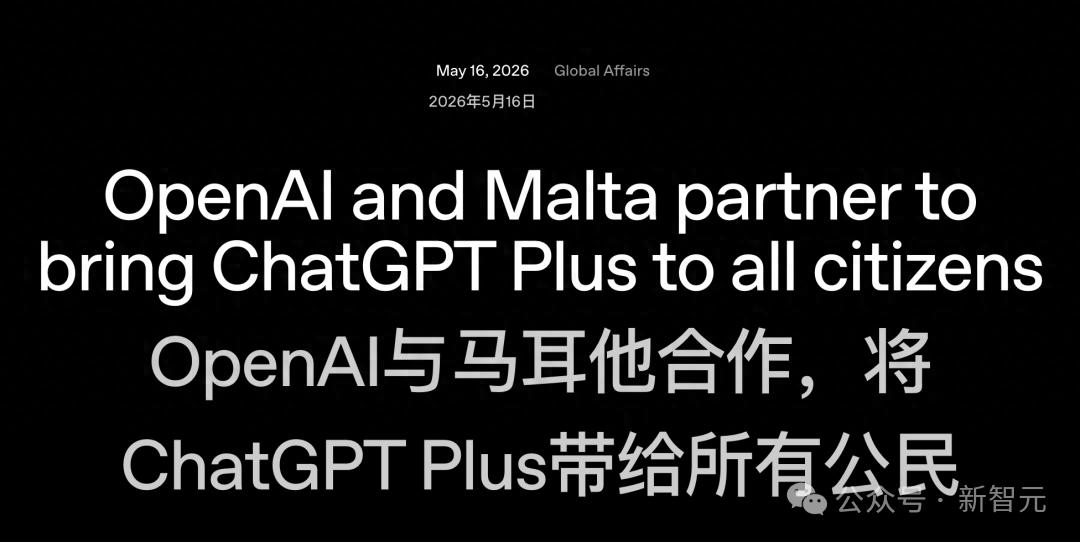
OpenAI has officially announced a partnership with the government of Malta, providing all Maltese citizens with one year of free access to ChatGPT Plus, funded by the state. This initiative marks the world’s first national-level AI tool accessibility program.
Education Before Access
The program includes a prerequisite: citizens must complete an AI literacy course developed by the University of Malta, covering basic AI principles, capabilities, and responsible usage in both home and work environments. Only after completing the course will citizens qualify for the free year of ChatGPT Plus.
The first users will gain access starting in May, with the distribution managed by the Malta Digital Innovation Authority, eventually extending to Maltese citizens living abroad.

A Noteworthy Approach
This “education first, tools later” strategy stands out. Most countries’ AI policies focus on regulation—enacting laws, establishing ethics committees, and limiting data usage. Malta, however, provides tools directly to citizens while ensuring they understand how to use them responsibly.

What Does OpenAI Gain?
At first glance, this appears to be a subscription revenue opportunity. With a population of approximately 574,300, if every citizen subscribed to ChatGPT Plus at $20 per month, the total annual cost would be around $130 million—insignificant for OpenAI. The real benefits lie elsewhere.
User Scale
Sam Altman has often likened intelligence to electricity, and OpenAI reiterated this in its announcement, referring to AI as a “global utility.” The business logic of utilities is that scale is everything. Currently, ChatGPT has over 900 million weekly active users, but competitors like Claude, Gemini, and Grok are quickly capturing market share. Acquiring users through government channels is an efficient way to establish brand loyalty. The first AI tool someone uses is likely to become their long-term choice.
Data Feedback Loop
More users translate to more real-world interaction data, which feeds back into model training and product iteration. Every question, correction, and usage scenario on ChatGPT helps OpenAI understand the distribution of human needs. For a company aiming for AGI and ASI, the diversity of data is invaluable. The questioning patterns of Maltese teachers, fishermen, and civil servants differ significantly from those of Silicon Valley engineers—this is the training signal needed for a more generalized model.
Demonstration Effect
When OpenAI seeks to pitch its collaboration model to other countries, being able to say, “We have helped multiple nations achieve widespread AI accessibility” serves as a compelling reference. Malta acts as a prototype, with the real target audience being medium-sized countries that are still observing.
George Osborne, former UK Chancellor and current head of OpenAI for Countries, stated, “Intelligence is becoming a national utility… Malta is leading the way, and we hope other countries will follow.”

Which Countries Can Replicate This Model?
The financial feasibility of Malta’s plan heavily depends on its population size. A rough calculation shows that for a country with 1 million people, the total cost for full coverage would be around $240 million annually at $240 per person. For a country with 5 million people, the cost would be about $1.2 billion, and for 10 million people, it would approach $2.4 billion.
In reality, not everyone will complete the course and activate their accounts. Assuming an activation rate of 30%-50%, countries with populations under 5 million—like Estonia (1.36 million), Singapore (6.11 million), Luxembourg (682,000), and Iceland (392,000)—could financially manage this expense. OpenAI is already collaborating with Estonia and Greece on educational initiatives, making them likely candidates for early adoption.
For countries with populations over 10 million, the model of full government funding faces significant budgetary pressures. For example, Portugal (11 million people) would incur nearly $800 million annually at a 30% activation rate—an amount requiring substantial public discussion and justification for an economy with a GDP of approximately $290 billion. In larger economies like India, with 1.46 billion people, even covering just 10% would mean an annual expenditure exceeding $35 billion, surpassing India’s entire education budget for the 2026-2027 fiscal year (approximately $16.8 billion).
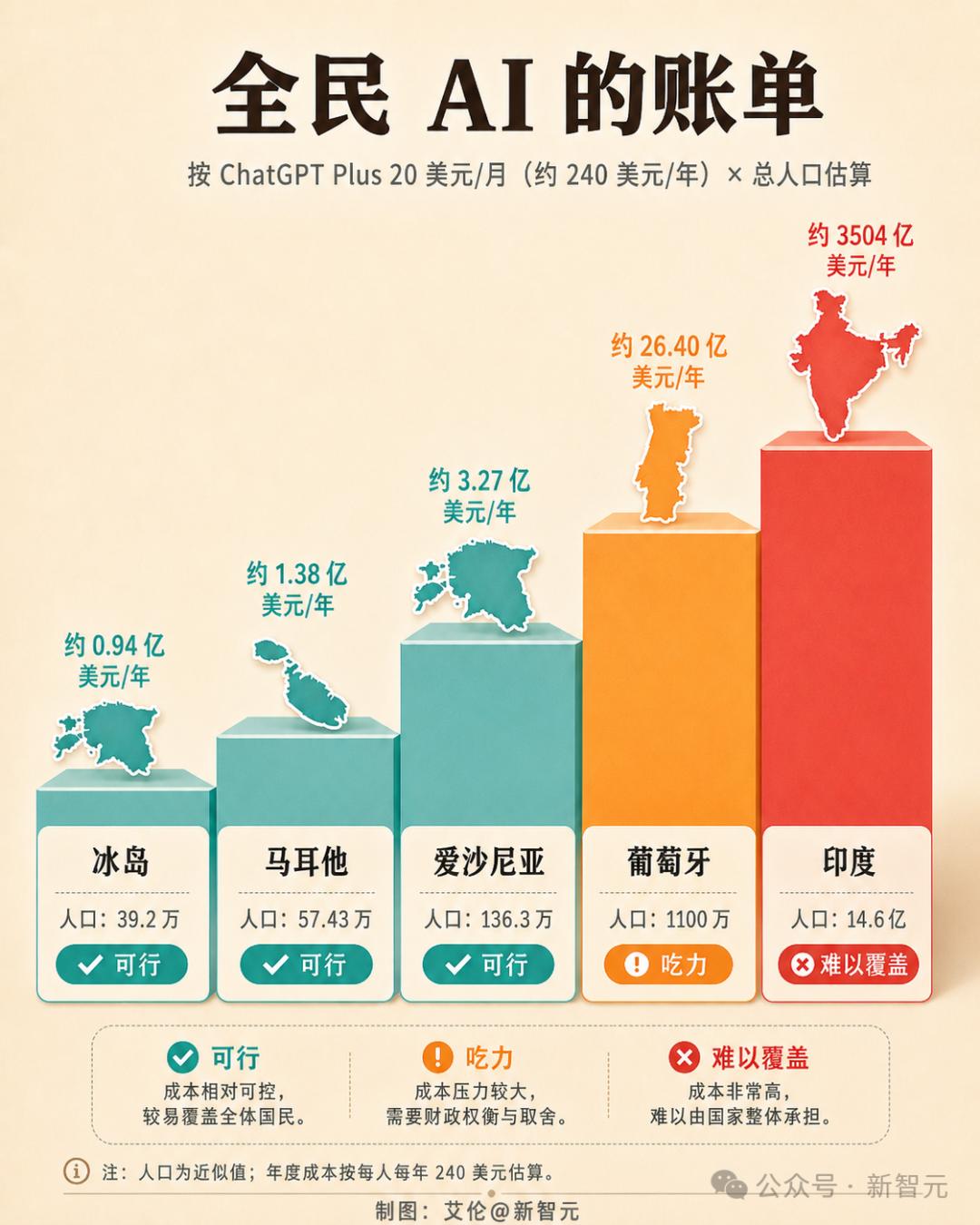
For populous nations, the path of “government-funded, universal coverage” is financially challenging. A more realistic approach might involve government subsidies for specific groups (teachers, civil servants, university students) or negotiating significant discounts on national licensing agreements with AI companies.

A Race to Build Infrastructure
The underlying logic of the Malta project resembles the historical development of electric and telephone networks: once infrastructure is established, the cost for later entrants to replace it is high. OpenAI’s strategy is that when AI becomes a daily essential tool, the first platform to cover users will gain a level of stickiness akin to that of an operating system.
The real question this experiment seeks to answer is whether the bottleneck for AI accessibility lies in the availability of tools or the capability to use them. If many Maltese citizens abandon the tool after completing the course, it indicates a lack of demand scenarios. Conversely, if usage rates continue to rise, OpenAI will have a strong case to present to more countries.
For those monitoring this field, one key metric to watch is the monthly active retention rate six months after the Malta project launches. This figure will determine whether “national funding for universal AI” is a replicable public service innovation or merely an expensive marketing campaign.
Comments
Discussion is powered by Giscus (GitHub Discussions). Add
repo,repoID,category, andcategoryIDunder[params.comments.giscus]inhugo.tomlusing the values from the Giscus setup tool.